

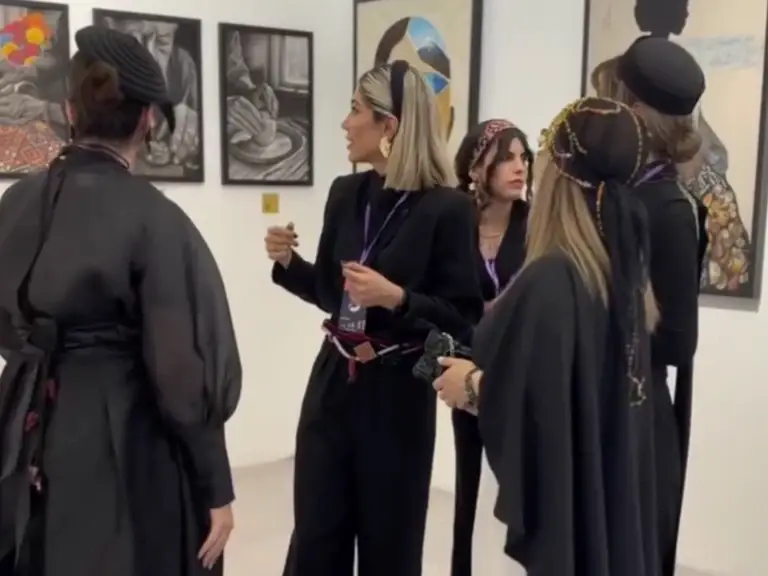
Women, some without headscarves, view artworks at Tehran Art Fair, held at the Iran Mall commercial complex in October 2026
As growing numbers of Iranian women appear in public without headscarves, authorities are pursuing organizers of cultural and sporting events over alleged violations of mandatory hijab rules.
Tehran’s prosecutor’s office announced this week that it had opened a case against the organizers of Tehran Art Fair, a privately run event held at the Iran Mall commercial complex from September 20 to 23, citing “failure to observe legal and religious requirements.”
The organizers have been summoned to court, while the fair’s ticketing website and social media account have been blocked on the prosecutor’s orders.
The announcement did not specify which activities at the event, which featured visual arts, music, theater and performance art, were considered violations.
Images and videos showed numerous female visitors without headscarves, as well as women performing without hijab.
In one performance, two women sat on the floor as red yarn was wrapped around them in a spiderweb-like pattern. Their bodies were then decorated with flowers before two other women cut the threads with scissors, freeing them.
Another video circulating on social media showed a woman in a long black dress that covered her body but left her head uncovered as she moved to music.
‘Offending public sentiment’
The action against the art fair came amid similar proceedings over Fitex Tehran, a sports equipment exhibition where women performed fitness routines and acrobatics to music without headscarves.
The judiciary announced Tuesday that an unnamed fitness blogger had been arrested on charges of “offending public sentiment” and “propaganda against the system.”
Videos of the performances, in which women wore long-sleeved tops and leggings but no headscarves, circulated widely on social media.
The prosecutor’s office ordered the event’s social media account closed for publishing “criminal content” and said an arrest warrant had been issued for one of the exhibition’s organizers.
The event drew criticism from conservative media. Tasnim, affiliated with the Revolutionary Guards (IRGC), condemned what it called widespread “deviations” at Fitex in an October 25 report and urged sports authorities and other institutions to intervene.
State broadcaster IRIB also described the event as an example of “deviance” and called for judicial action.
Beyond the exhibitions
Other cultural events have faced scrutiny over the past year, including music and theater performances and Tehran Design Week, held at the University of Tehran’s College of Fine Arts.
In some cases, judicial intervention has concerned interactions between women and men rather than hijab violations.
Last month, those involved in the play Tehran, Paris, Tehran/Bridge faced prosecution after a scene showed a female actor briefly resting her head on the chest of a male actor playing her brother.
The prosecutor’s office described the actors’ behavior as “contrary to tradition and propriety.”
Authorities have also taken action against venues hosting events attended by women without hijab.
Earlier this month, the IRGC-linked Fars News Agency reported that a banquet hall in the religious city of Qom had been sealed on the prosecutor’s orders after the wife of prominent soccer player Ali Daei attended a private company conference there without a headscarf.
A judicial case was also opened against the conference organizers, and the prosecutor warned that everyone involved would face action.
Changing streets, unchanged laws
Since the 2022 Woman, Life, Freedom movement, which followed the death in custody of Mahsa Amini, street-level enforcement of compulsory hijab has declined.
Increasing numbers of women now appear in public without headscarves, wearing clothing other than the long coats and chadors traditionally expected by authorities. Women also exercise in public parks without covering their hair.
But mandatory hijab rules remain in force, including in schools, government institutions and universities, while organizers of public events continue to face legal pressure.
Women’s rights activists and opponents of mandatory hijab argue that the growing visibility of women without headscarves does not amount to freedom of choice as long as legal restrictions remain.
The recent prosecutions show how authorities continue to enforce those restrictions through legal action against organizers, performers and venues, even as uncovered hair becomes increasingly commonplace in public.